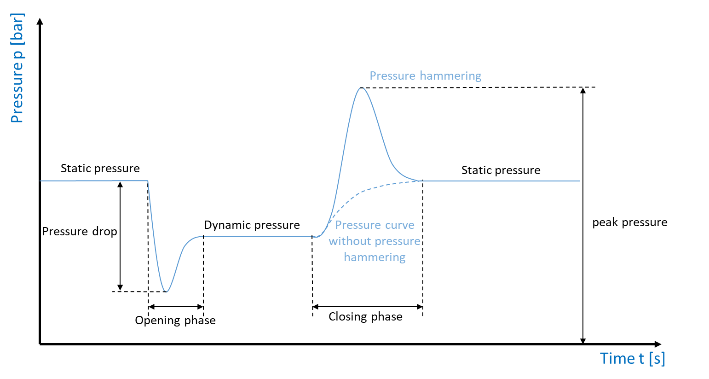
During opening and closing operations, the pressure conditions within piping systems change between static pressure and flow pressure. The resulting pressure amplitudes within the system depend on several factors, including:
- System pressure
- Hydrostatic pressure
- Pipe cross-section
- Temperature
- Type and mass of the medium
- Opening and closing characteristics of the valve
In many cases, the system parameters are known, with the exception of the switching behavior of the valves. The effects of pressure peaks, for example those caused by water hammer, can range from harmless to severe. In less critical cases, pressure surges may only result in vibrating pipes, as can already occur in domestic plumbing systems. In more serious cases, pressure peaks may reach several times the nominal pressure and can therefore cause damage to system components.
Vacuum shock
When a valve is opened, the flow force builds up with a delay due to the inertia of the medium. As a result, the pressure in the system decreases until the steady-state flow pressure is reached. Since the pressure decreases during this process, a vacuum shock generally does not pose a risk to the system.
Pressure shock / water hammer
When a valve is closed, the inertia of the flowing liquid opposes the movement because the medium must be decelerated. This results in pressure peaks that can reach several times the nominal pressure and may potentially damage the system.
Measures to prevent pressure surges
To reduce pressure surges, so-called water hammer arrestors can be installed directly into the piping system. For maximum effectiveness, these dampers should be installed as close as possible to the source of the pressure surges, i.e. directly downstream of the valves.