Elastomer seals in the form of diaphragms or as sealing elements in pistons are only suitable for valves with nominal diameters of 10 mm or more to a limited extent for high pressures and can usually only be used up to 20 bar. High pressure loads combined with potentially high temperatures, spring forces, or many switching cycles lead to comparatively rapid damage to the seal and thus to valve failure. Established alternatives to NBR, EPDM, or FKM are PTFE, PEEK, POM, or PBT.
Sealing capability
Unlike elastomer seals, hard seals made of PTFE, PEEK, POM, or PBT usually have a lower sealing effect. In many applications, however, this only causes a problem at low pressures, as the tightness at the valve seat increases with rising pressure in the operation of 2/2-way solenoid valves, for example.
Chemical and temperature resistance
A comparison of the chemical resistance of PTFE, PEEK, POM, and PBT shows that PEEK and PTFE in particular exhibit excellent resistance to a wide range of chemicals. PBT generally has an average resistance and can be used with neutral liquids and weak chemicals. POM is generally considered to be slightly less resistant to chemicals than PBT. PBT and POM in particular also have a lower temperature resistance in comparison of all four materials.
Costs and machinability
In terms of costs, PBT and especially POM are by far the most economical materials of the four thermoplastics. Although PEEK can be machined well, it comes with considerable material costs.
PTFE is cheaper in comparison, but has limited machinability as it warps easily, which leads to difficulties, especially with thin wall thicknesses and filigree structures.
PBT and POM, on the other hand, have low material costs and good machinability.
| Sealing capability | Chemical resistance | Temperature resistance | Costs | CNC machinability (complex shapes) | |
| Elastomere | Very good | Avg. to very good | Avg. to good | Low to high | |
| PTFE | Average | Very good | Very good | Medium to high | Difficult |
| PEEK | Average | Very good | Very good | High | Very good |
| PBT | Average | Avg. to good | Average | Average | Very good |
| POM | Average | Average | Average | Low to medium | Very good |
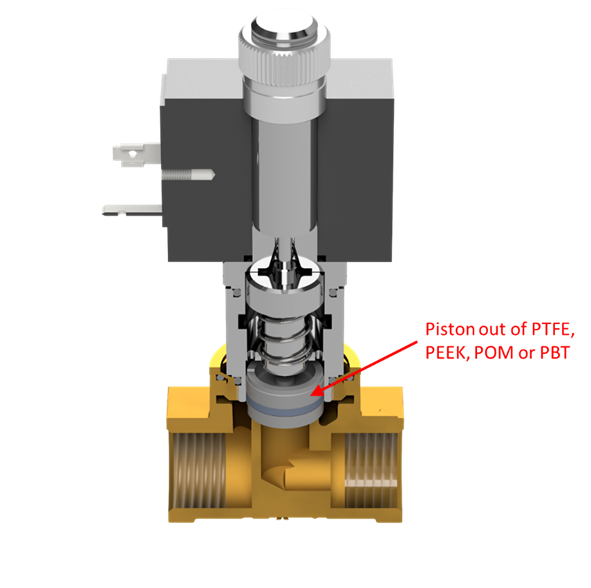
The following cross-sectional drawing of a valve with G1/2 connections and a nominal diameter of 10 mm shows a practical implementation as an NO valve with a piston made of a thermoplastic material for the main nozzle.