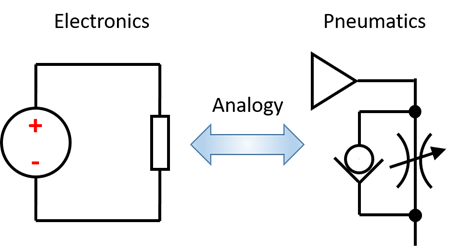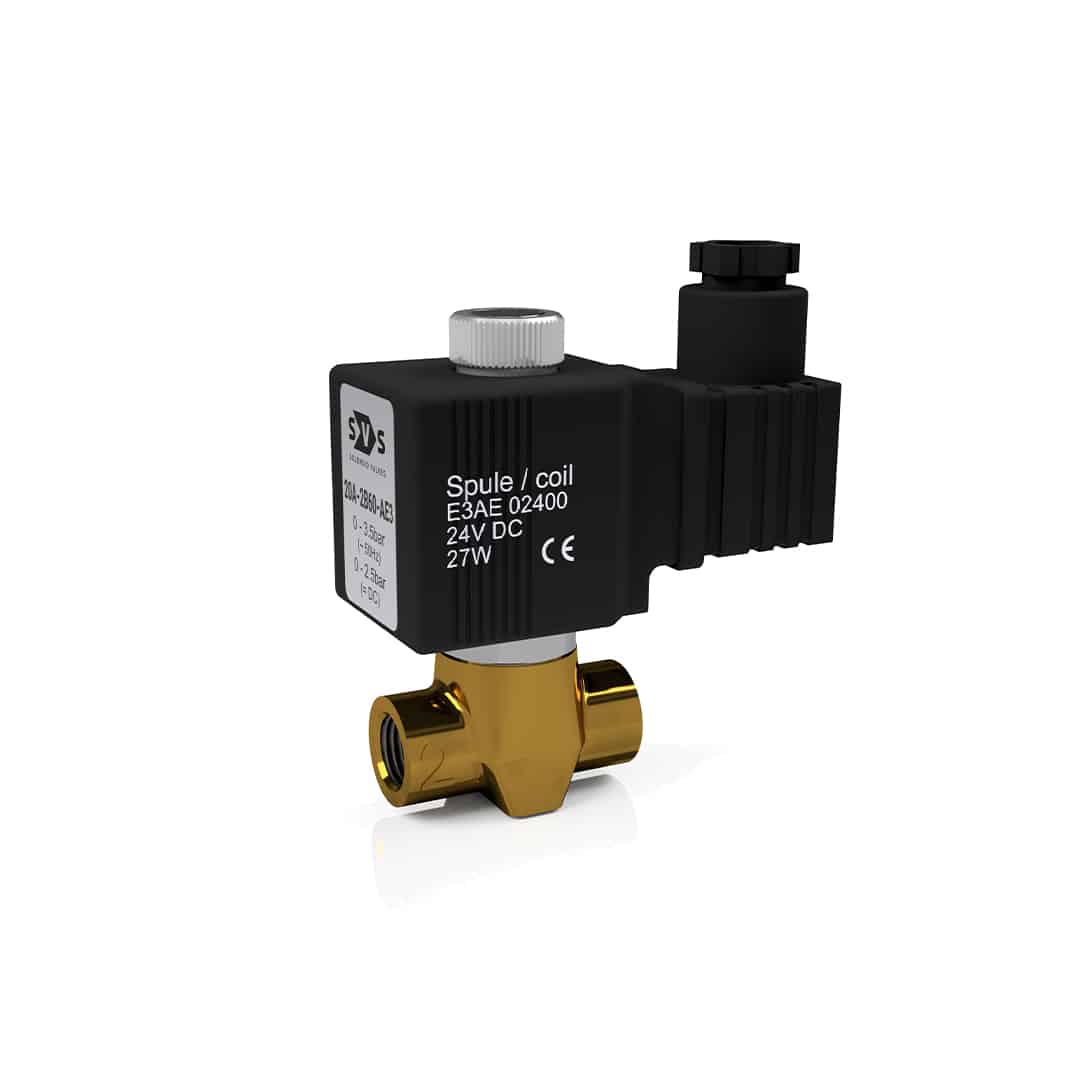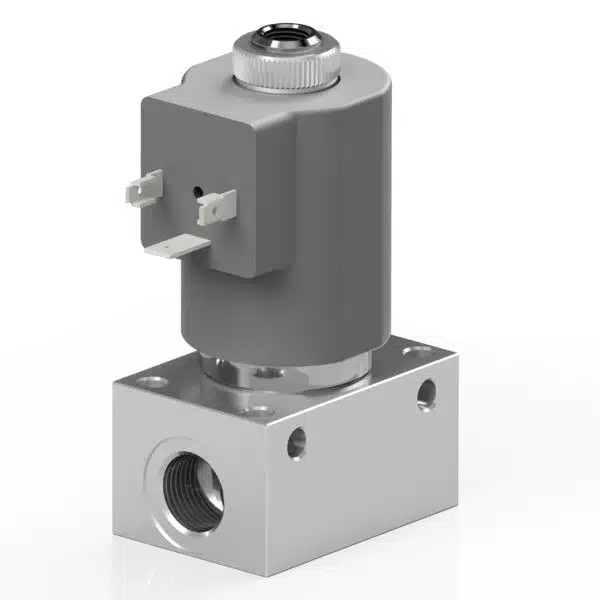
At first glance, electrical and pneumatic systems appear to be fundamentally different, but they are based on very similar descriptions that can be easily compared. The core of this analogy lies in the fact that both systems transport energy via a medium: Electrical engineering uses electrical charge carriers, while pneumatics moves compressed air. The type of medium is different, but the relationships between the physical quantities are surprisingly similar – especially between voltage and pressure, current and flow, and resistance and flow restrictors.
The electrical voltage U measured in volts [V] corresponds to the pressure p measured in pascals [Pa] in the pneumatic system. Both quantities represent a potential difference that causes the movement of charge carriers or air. Without a voltage or pressure difference, neither current nor air flows – both systems therefore require a potential gradient.
The electrical voltage U measured in volts [V] corresponds to the pressure p measured in pascals [Pa] in the pneumatic system. Both quantities represent a potential difference that causes the movement of charge carriers or air. Without a voltage or pressure difference, neither current nor air flows – both systems therefore require a potential gradient.
Finally, the electrical resistance R measured in [Ω] finds its pneumatic counterpart in flow restrictors or porous structures that limit the airflow. Analogous to electrical resistance, which limits the flow of current in a circuit, a flow restrictor, for example, reduces the airflow caused by a pressure difference. Both elements convert energy into heat and are used to precisely control the flow, for example to regulate speed or system damping. These analogies enable an intuitive understanding of pneumatic behaviour using electrical models that are more familiar to many users. They form the basis for further considerations in the following parts of this series, in which more complex elements such as capacitors, coils, transistors, and voltage regulators are translated into pneumatic equivalents.
Electrical voltage

Electrical current

Electrical resistance

Equivalent in pneumatics
Laminar flow

Turbulent flow
In pneumatics, rough turbulent flow often occurs, resulting in a quadratic dependence of the pressure losses Δp on the flow rate Q. Analogous to electrical engineering, Rₜᵤʳᵇ now applies and the relationship