Thermopneumatic valves can be classified in the group of thermally actuated valves, such as bimetal valves and valves with shape memory alloys, and represent a niche solution that is mainly used in micropneumatics.
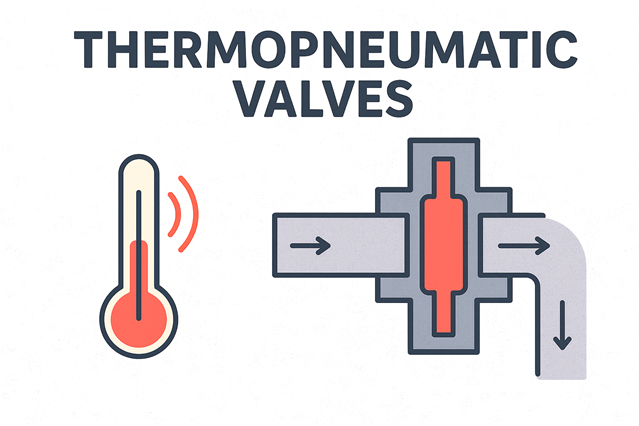
Thermopneumatic valves are switching elements that control pneumatic functions through specific temperature changes. Instead of mechanical or electromagnetic actuators, the principle is based on the thermal expansion of a medium, usually air or another gas, which is enclosed in a cavity. When the medium is heated, the pressure rises and moves a flexible membrane that opens or closes a microchannel by opening or closing a valve seat or a fluidic channel. When cooled, the membrane returns to its original position.
This principle is particularly suitable for microfluidic and micropneumatic systems, as it does not require any moving macro parts and can be easily integrated into planar chips.
Other advantages include simple design, low manufacturing costs, good miniaturization potential, and the forces and strokes that can be achieved.
Disadvantages include the comparatively slow response time due to thermal inertia, possible material stress due to cyclic heating, and high energy consumption.
Nevertheless, thermopneumatic valves are a proven solution for compact, cost-effective micro and low-pressure systems.